No products in the cart.
No products in the cart.
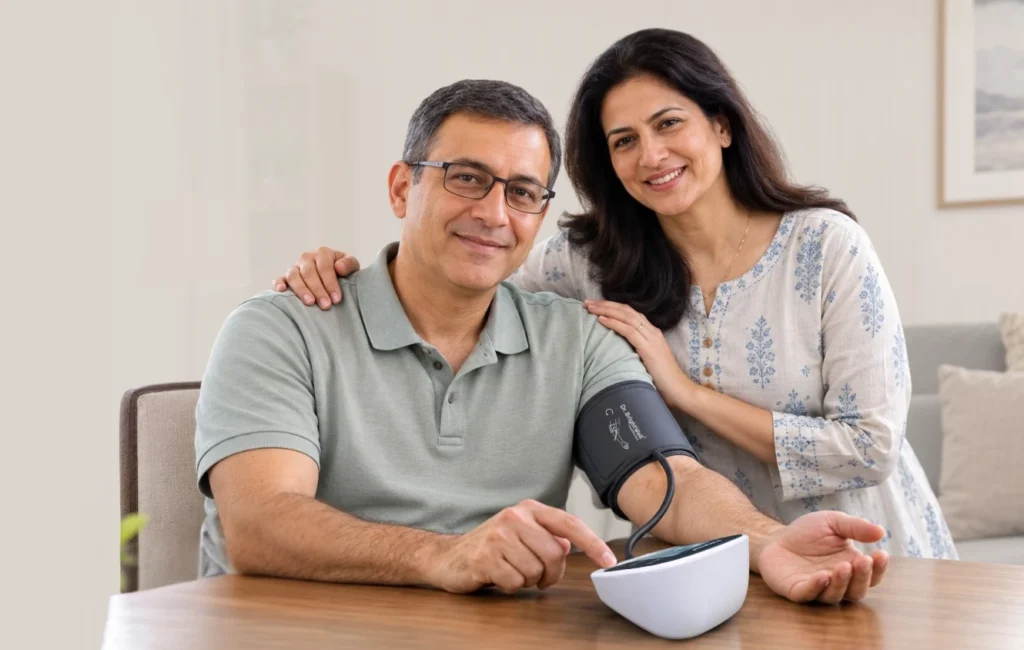
If you’re wondering how to use a BP monitor at home correctly, you’re not alone. More families today rely on digital blood pressure machines for routine health tracking, but small mistakes in posture, cuff placement, or timing can lead to inaccurate readings. This guide explains the BP machine step by step process, common mistakes to avoid, and how to make every home BP check more reliable.
But here’s the important part: using a BP monitor incorrectly can give misleading readings. Even small mistakes—like sitting in the wrong position, placing the cuff over clothing, or checking right after tea, coffee, or climbing stairs—can affect your results.
That’s why learning how to use BP monitor devices correctly matters just as much as owning one.
In this guide, we’ll explain how to use a BP monitor at home correctly, cover the BP machine step by step process, and share practical tips to make every home BP check more accurate and reliable.
Home blood pressure monitoring can help you:
However, for home readings to be useful, they need to be taken properly. Health authorities such as the American Heart Association and CDC recommend using a validated upper-arm blood pressure monitor, sitting correctly, resting before the reading, and taking multiple readings for better accuracy.
If you’re wondering how to use BP monitor devices the right way, follow this simple routine every time.
For a reliable home BP check, avoid measuring blood pressure:
It’s also a good idea to empty your bladder before the reading and sit quietly for a few minutes. These small steps can make a noticeable difference in your result.
Best practice: Try taking your readings at the same time each day, such as morning before breakfast or evening before dinner, unless your doctor has advised a different schedule. Consistency helps you compare readings more accurately over time.
Your posture has a direct impact on your reading. Before you begin:
Think of this as the “ready position” for a correct home BP check. If your body is tense or unsupported, your reading may be higher than it actually is.
This is one of the most important parts of the BP machine step by step process.
Using the cuff over a shirt sleeve or placing it too low/high can affect the reading.
Helpful note: A home monitor is only as good as its cuff fit. If the cuff is too small or too large for the user’s arm, the reading may be inaccurate. When choosing a home BP machine, cuff size and fit are worth checking carefully.
Rest the arm on a table, pillow, or arm support so that the middle of the cuff is at heart level.
This detail is often overlooked, but it matters a lot. If the arm hangs too low, the reading may come out falsely high. If it’s held awkwardly, muscles tense up and can interfere with the measurement.
A simple setup at home:
Now you’re ready to begin the reading.
The machine will display two numbers:
If your monitor also shows pulse rate, note that down too.
A single reading doesn’t always tell the full story.
For a better home BP check, take:
In many people, the first reading can be slightly higher because the body is still settling. Taking two readings gives a more dependable picture. Some clinicians may also advise taking morning and evening readings over several days for better tracking.
For seniors, caregivers, or anyone tracking blood pressure regularly, a monitor with memory storage can be especially useful. It makes it easier to compare readings over time without writing every number down manually.
Once the reading appears, note:
This helps you and your doctor spot patterns more clearly.
You can maintain:
For many families, a digital machine with memory recall can make regular tracking much easier—especially for elderly users or caregivers who monitor readings daily.
Here’s the BP machine step by step process in one quick view:
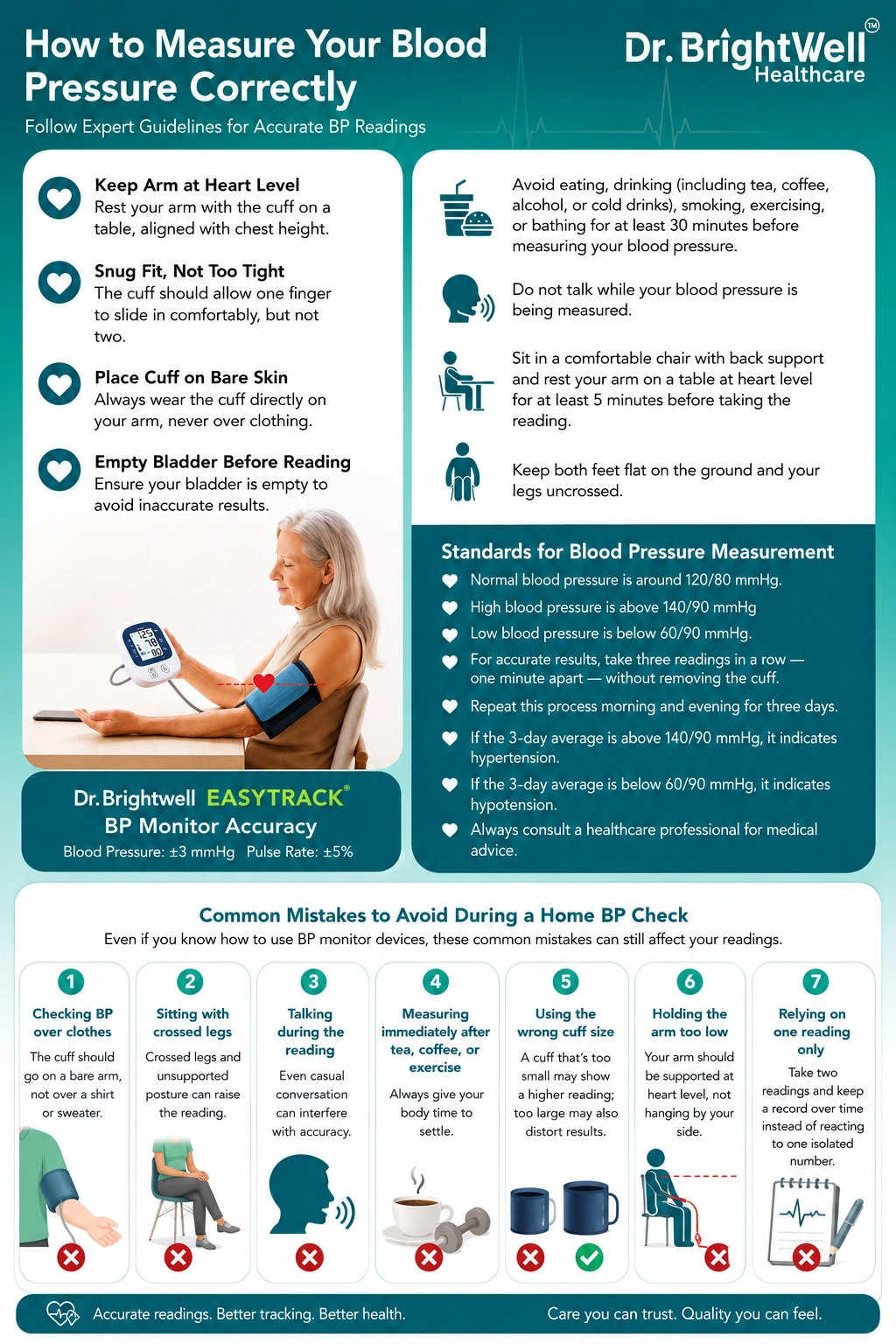
Even if you know how to use BP monitor devices, these common mistakes can still affect your readings.
The cuff should go on a bare arm, not over a shirt or sweater.
Crossed legs and unsupported posture can raise the reading.
Even casual conversation can interfere with accuracy.
Always give your body time to settle.
A cuff that’s too small may show a higher reading; too large may also distort results.
Your arm should be supported at heart level, not hanging by your side.
Take two readings and keep a record over time instead of reacting to one isolated number.
In general, use the arm your doctor recommends. If you’ve never been told which arm to use, many guidelines suggest checking both arms initially and then using the arm with the higher reading for future measurements.
What matters most is using the same arm consistently for future readings so comparisons remain meaningful.
This depends on why you’re monitoring blood pressure.
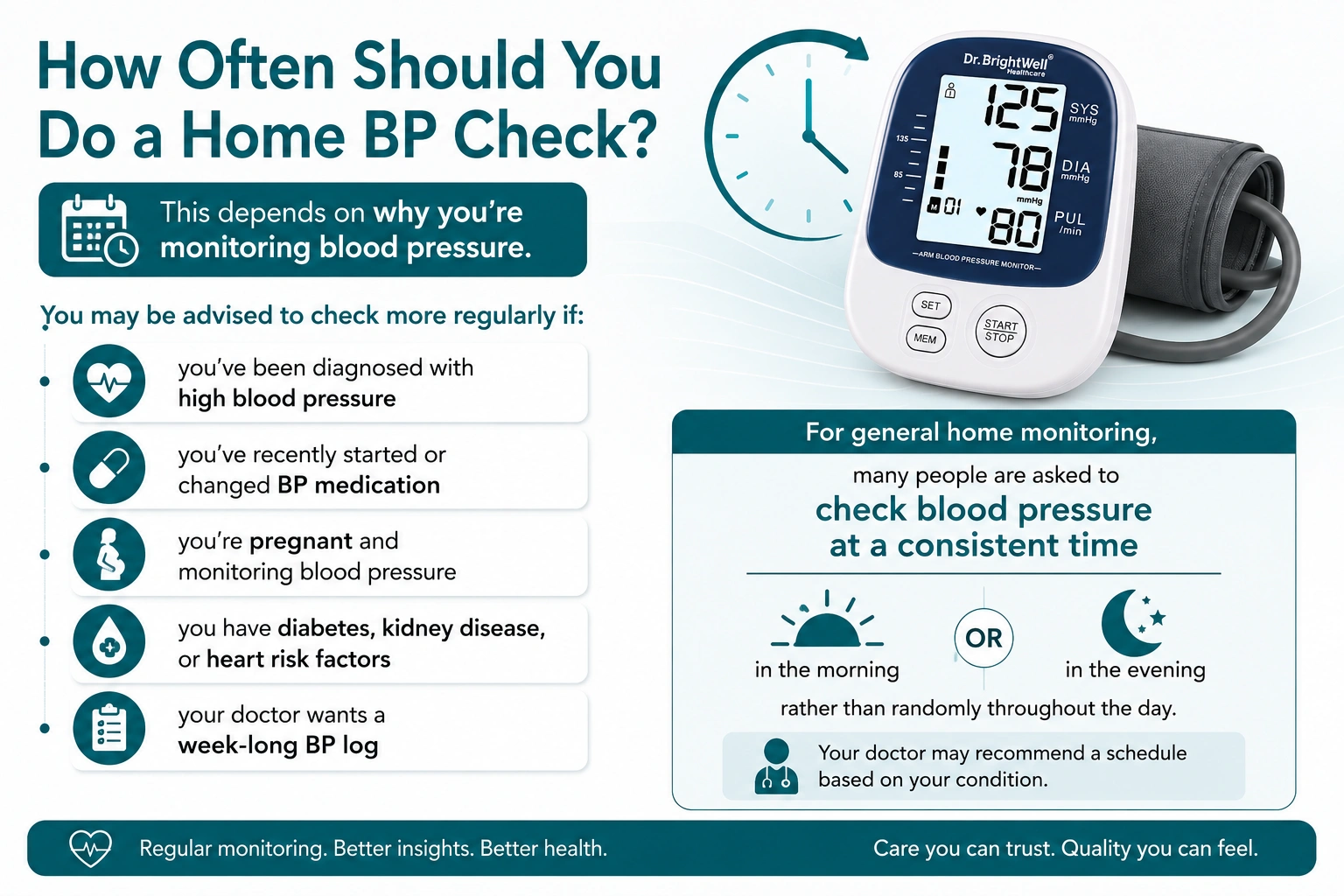 For general home monitoring, many people are asked to check blood pressure at a consistent time in the morning and/or evening, rather than randomly throughout the day. Your doctor may recommend a schedule based on your condition.
In adults, blood pressure readings are interpreted based on overall health context, age, medical history, and doctor guidance. Instead of self-diagnosing from one number, look at patterns across multiple readings.
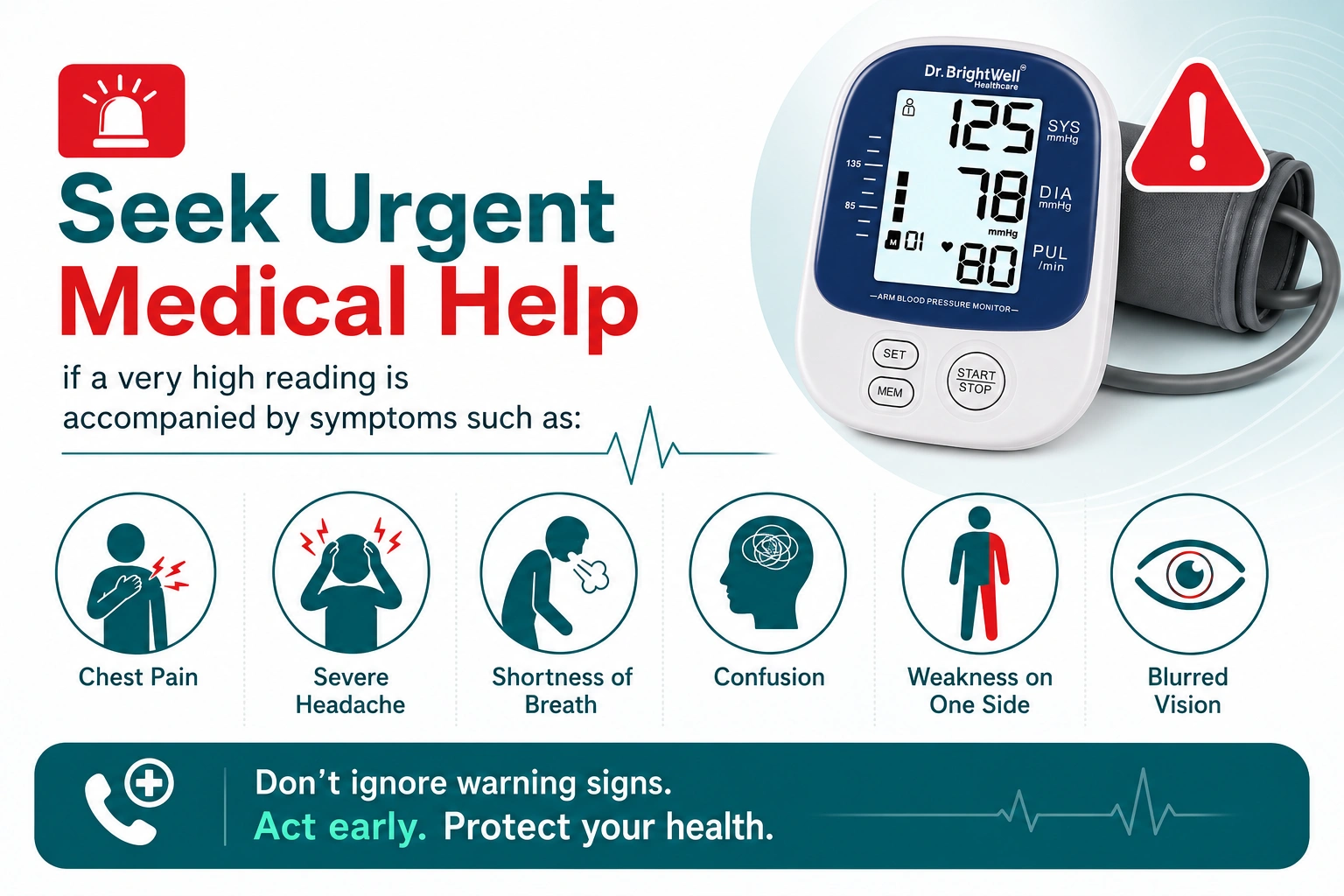
If you’re learning how to use BP monitor devices at home, it helps to start with the right machine.
Look for:
If you’re planning regular blood pressure monitoring at home, choose an automatic upper-arm monitor that is easy to read, simple to operate, and comfortable to use for all age groups. Features like a clear digital display, proper cuff fit, one-touch measurement, and memory storage can make daily monitoring much easier. For families looking for a practical home-use option, Dr.Brightwell offers blood pressure monitoring solutions designed to support simple and dependable home health tracking.
Learning how to use BP monitor devices correctly is one of the simplest ways to make home health monitoring more useful and trustworthy.
A proper home BP check isn’t just about pressing a button. It’s about:
Once you follow the right BP machine step by step method, your readings become more meaningful—not just for you, but also for the doctor helping you manage your health.
If you’re planning to monitor blood pressure regularly at home, choose a reliable upper-arm monitor, learn the correct technique, and make it part of your routine. A few careful minutes each day can go a long way in supporting long-term heart health.
Sit quietly for 5 minutes, place the cuff on a bare upper arm, support your arm at heart level, keep your feet flat on the floor, stay silent during the reading, and take 2 readings one minute apart.
It’s better to wait at least 30 minutes after tea, coffee, smoking, or exercise before taking a reading.
It should feel snug but not painful. You should be able to slide two fingertips under the cuff.
Usually, 2 readings one minute apart are recommended for a more accurate home BP check.
No. The cuff should be placed on a bare upper arm for a more accurate reading.
Upper-arm monitors are generally preferred for home use because they are usually more reliable when used correctly.